How Perplexity Picks Its Sources — And How to Get Cited
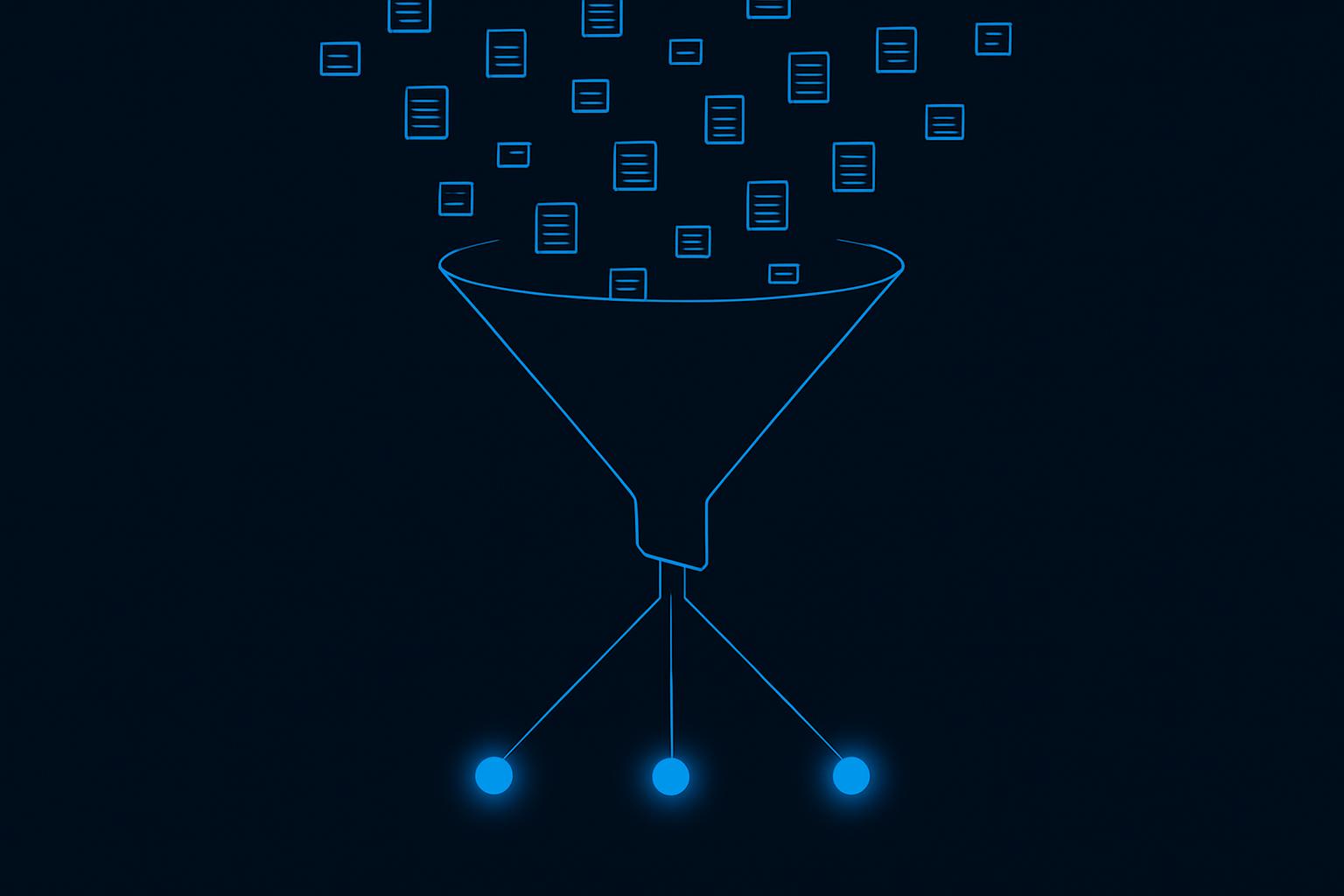
Perplexity does not rank pages. It cites sources. That single distinction breaks most of the SEO instincts founders carry into AI search. On Google, position 7 still gets a sliver of traffic. On Perplexity, you are either in the answer or you are invisible — there is no page two. The pipeline reads a small candidate pool per query and quotes only a handful of it.
The practical numbers make the stakes clear. Across studies, Perplexity reads roughly ten pages per query but cites only three to five, and on complex Pro-mode research it may surface ten or more. Perplexity typically cites between 3-8 sources per response, depending on query complexity; simple factual queries may cite 2-3 sources, while complex research queries in Pro mode can cite 10+ sources. If you understand how that shortlist gets built, you can engineer your way onto it. This is the core of Generative Engine Optimization, and Perplexity is the cleanest engine to study because it shows its work.
Perplexity runs a retrieval-then-rerank pipeline, not a ranking list
Perplexity is built on Retrieval-Augmented Generation (RAG), which means the model synthesizes from documents it pulls in real time rather than from memory alone. The retrieval system operates before the LLM, meaning the language model synthesizes from pre-selected evidence rather than generating from memory alone. That architectural fact is the whole game: if your page never enters the candidate pool, nothing else about your content matters.
The pipeline is multi-stage. Step 1: Query decomposition — Perplexity analyzes the user's question and breaks it down into multiple search sub-queries; a complex question can generate 3 to 5 distinct searches. Step 2: Real-time web search — the system queries its index and retrieves about ten potentially relevant pages, analyzed for content, structure, and authority. Step 3: Extraction and synthesis — the AI extracts the most relevant passages from each page, compares them, and synthesizes them into a coherent response. Step 4: Source attribution — Perplexity selects 3 to 4 sources from the analyzed pages and explicitly cites them.
The step that eliminates most content is reranking. According to third-party reverse-engineering studies (which Perplexity has not officially confirmed), the ranking process moves through five sequential stages: intent mapping, retrieval, quality assessment, machine-learning reranking, and final selection. The reranking layer uses multiple model filters, including an XGBoost model for entity-based queries, to separate retrieved pages from cited ones. That gap between being retrieved and being cited is where most content fails. Being crawled is necessary but not sufficient — a point I make often in Why ChatGPT Can't See Your Website, and it applies just as hard here.
Note the query decomposition step. It is the same fan-out behavior that drives Google AI Overviews citation selection — one question becomes several searches, and you need coverage across the sub-questions, not just the headline phrase.
Topical authority can beat domain authority on Perplexity
This is the most important — and most encouraging — finding for founders without a large backlink profile. Perplexity weights relevance and content quality more heavily than raw domain size. Perplexity prioritizes content quality and relevance over domain size; niche expertise, original data, and authentic community presence can earn citations regardless of website authority metrics. Domain authority appears to be a relatively minor input. Domain authority accounts for roughly 15% of Perplexity's ranking weight according to practitioner research, but the platform does not simply read Moz or Ahrefs scores.
The pattern shows up in real citations. One of the most counterintuitive findings: topical authority outweighs domain rating in Perplexity's citation model. A niche blog focused on agency operations was cited over large general publishers for a specific comparison query. This directly contradicts traditional SEO logic, where domain authority strongly predicts ranking. On Perplexity, a focused SaaS blog can outrank Forbes for a narrow query if it answers more precisely. That reality reshapes where I land in the "GEO is just SEO" debate: the retrieval mechanics genuinely differ.
Freshness is a stronger signal on Perplexity than almost anywhere else
Perplexity maintains a continuously updated index with no fixed knowledge cutoff, so recent content can surface fast. Perplexity maintains a continuously updated index with no fixed knowledge cutoff; fresh content can appear in citations within days of publication, making regular updates more valuable than on other AI platforms.
The decay is steep. Freshness is a particularly strong signal on Perplexity compared to other AI search engines. Content published or updated within the last 30 days receives a measurable citation boost, and for rapidly developing topics, that window can compress to 48 to 72 hours. One analysis put the effect in concrete terms: Perplexity strongly favors recent content — content updated within the last 30 days gets 3.2x more citations than older material, making systematic refresh schedules essential for sustained visibility. The takeaway is operational: a quarterly refresh cadence with visible "Updated [month/year]" timestamps is not cosmetic. It is a ranking input.
Structure determines whether your answer can even be extracted
Perplexity lifts passages, not whole pages, so the answer has to be near the surface. The dominant pattern in cited content is answer-first. 90% of top-cited sources answered the core question within the first 100 words. This "Bottom Line Up Front" (BLUF) pattern means Perplexity's retrieval system favors pages where the direct answer appears early. Long introductions or buried answers get deprioritized during snippet extraction.
Structured data compounds the effect. According to Onely, schema-enabled pages achieve 47% Top-3 citation rates compared to 28% without — a 19-percentage-point advantage. JSON-LD is the preferred format, and pages with Person schema including author credentials achieve 2.3x higher citation rates. Structure alone moves the needle even before you improve the writing: structural optimization alone, independent of content quality, has been shown to increase citation rates by around 17% across generative engines. The mechanics of doing this well — passages, schema, and extractable headings — are exactly what I cover in How to Make Your Content Citable by AI.
Semantic completeness wins the shortlist
Depth across the full topic, not just the headline keyword, is the strongest single predictor in practitioner data. Semantic completeness is the strongest individual predictor of citation selection according to practitioner research, with a high correlation to citation outcomes. A page that thoroughly covers a topic, names specific entities, and answers related sub-questions in the same piece is far more likely to be cited than a page that covers the same topic shallowly. Because the query gets decomposed into sub-questions, the page that answers all of them in one place tends to win.
The citation data tells you where to compete
Perplexity's source mix is distinct from other engines, and that should drive strategy. Across a large sample, the leader is youtube.com, capturing 32.4% of citations — the most concentrated top source of any assistant. Community content punches far above its weight: the platform's most striking characteristic is heavy Reddit reliance. Reddit accounts for 46.7% of Perplexity's top 10 citations, more than three times the share of its next most-cited source, YouTube. This is why I put Reddit at the center of the ARC Method and wrote a whole piece on why Reddit dominates AI search citations.
There is also meaningful overlap with traditional search, but it is not the whole story. Nearly 1 in 3 of Perplexity's citations point to pages that rank in the top 10 for the target query, though 67% still come from outside page one of Google results. So ranking on Google helps, but two-thirds of citation slots go to pages that don't. That is your opening.
The engines diverge enough that a single playbook fails. You cannot optimize for "AI search" as a monolith. ChatGPT wants Wikipedia mentions and Bing-friendly structure. Claude needs formal citations and technical precision. Perplexity requires authentic Reddit engagement and recency signals.
Accuracy is imperfect — which is a reputation risk and an opportunity
Perplexity is the most accurate of the answer engines, and still wrong often. Eight AI chatbots were tested and, on average, they produced the wrong source 60% of the time; Perplexity performed best — and still got the citation wrong 37% of the time. The Columbia Journalism Review's Tow Center also found that despite its partnership with the Texas Tribune, Perplexity Pro cited syndicated versions of Tribune articles for three out of ten queries, while Perplexity cited an unofficial republished version for one.
For a SaaS brand, two implications follow. First, consolidate your facts: AI engines deprioritize brands whose details conflict across sources, so make your description, founding date, and category identical on your site, LinkedIn, G2, and Crunchbase. Second, monitor what Perplexity actually says about you, because confident-but-wrong is the default failure mode — the discipline I cover in AI Reputation Management.
The playbook, in order
If I were sequencing this for a SaaS founder, it would follow the 90-day GEO roadmap: confirm PerplexityBot can crawl you; restructure priority pages answer-first with the core claim inside the first 100 words; add Article, FAQ, and Person schema in JSON-LD; publish original data you own, since proprietary stats are the most quotable and least replaceable asset you have; build authentic Reddit presence in your category; earn a few credible third-party mentions; and set a refresh cadence so your best pages never go stale. The full method — Audit, Reddit and Reputation, Citability — is the spine of my book, Reddit, AI Overviews & GEO, and the through-line of everything I do at corymaki.com.
The brands that win on Perplexity over the next two years won't be the ones with the biggest domains. They'll be the ones producing content an answer engine can safely repeat: specific, dated, structured, and sourced to data they actually own.
Frequently asked questions
How many sources does Perplexity actually cite per answer?
Most analyses show Perplexity reads roughly ten candidate pages per query but cites only three to five in the final answer. Simple factual questions may use two or three sources, while complex Pro-mode research can cite ten or more. The key point is that retrieval is a wide net and citation is a narrow filter — being crawled does not mean being cited.
Does domain authority matter for getting cited on Perplexity?
Less than you'd expect. Practitioner research puts domain authority at roughly 15% of Perplexity's ranking weight, and the platform doesn't simply read Moz or Ahrefs scores. It prioritizes content relevance, freshness, structural clarity, and topical depth. In documented cases, niche blogs have been cited over large general publishers for specific queries — the opposite of how Google typically behaves.
How fresh does my content need to be?
Freshness is one of Perplexity's strongest signals. Content updated within the last 30 days has been shown to earn substantially more citations than older material, and for fast-moving topics the effective window can compress to 48–72 hours. A systematic refresh cadence with visible 'Updated [month/year]' timestamps is a genuine ranking input, not a cosmetic detail.
Why does Reddit matter so much for Perplexity visibility?
Citation studies have found Reddit accounts for a large share of Perplexity's top citations — in one dataset, about 46.7% of its top-10 citations, more than three times its next-most-cited source. Authentic, helpful participation in relevant subreddits is therefore one of the highest-leverage moves for Perplexity visibility, which is why it sits at the center of the ARC Method.
How can I tell if Perplexity is citing me correctly?
Run your priority queries directly in Perplexity and inspect the Sources panel to see which URLs and domains it grounds on. Then verify the facts it states about your brand. Accuracy is imperfect even on the best engine — the Tow Center found Perplexity still got source attribution wrong 37% of the time — so monitor for misstatements and keep your brand facts identical across your site, LinkedIn, G2, and other platforms to reduce ambiguity.
References
- Ahrefs — The 50 Most-Cited Websites in Perplexity (June 2026)
- Ahrefs — The 10 Most Mentioned Domains for ChatGPT, Perplexity, and AI Overviews Across 78.6M Searches
- Columbia Journalism Review (Tow Center) — AI Search Has a Citation Problem
- Nieman Journalism Lab — AI search engines fail to produce accurate citations in over 60% of tests
- ZipTie.dev — How Perplexity AI Answers Work: Retrieval, Ranking, and Citation Pipeline
- WP SEO AI — How does Perplexity AI decide which sources to cite in its answers?
- Discovered Labs — AI Citation Patterns: How ChatGPT, Claude, and Perplexity Choose Sources
- Stackmatix — Perplexity AI Optimization Strategy: Citation Guide (2026)
Cory Maki is an AI search strategist based in Taichung, Taiwan, specializing in GEO, AI reputation management, and AI branding for SaaS founders. Author of Reddit, AI Overviews & GEO and creator of the ARC Method. Read more →