How Claude Chooses and Cites Its Sources
Claude does not choose sources the way Perplexity or Google AI Overviews do. It runs on a different retrieval architecture, a different search provider, a different crawler stack, and a documented preference for conservative, high-authority sources. If you treat Claude as "another ChatGPT" and copy the same GEO playbook across all engines, you will misread where its citations come from — and you will optimize for the wrong surface.
This post breaks down Claude's actual source-selection and citation pipeline: when it answers from training versus when it searches the web, which crawler feeds which layer, how it decides what to cite, and why it cites fewer sources than its competitors. Source selection varies by engine — I've documented how Perplexity picks its sources and how Google AI Overviews choose citations via query fan-out separately, precisely because the mechanics don't transfer. Claude has its own, and it's worth understanding on its own terms.
Claude has two answer modes, and only one of them cites live sources
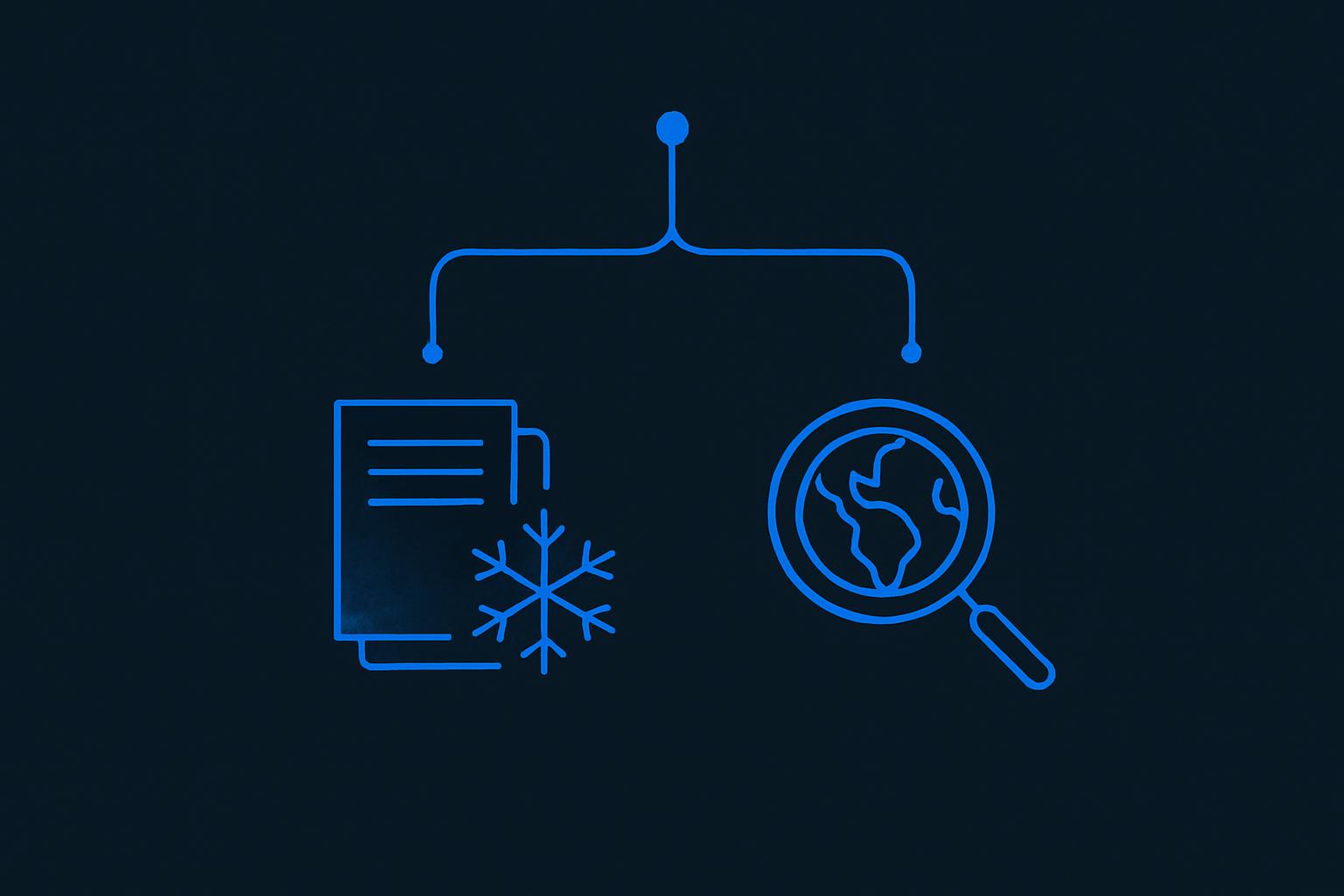
Claude's default behavior is to answer from its training corpus, not the live web. Web search is a tool the model chooses to invoke — it isn't reflexive. When the web search capability is enabled, Claude uses reasoning to determine whether a request would benefit from up-to-date information; if it decides to search, it generates a query, retrieves results, analyzes them, and provides an answer with citations. When it doesn't decide to search, you get a training-grounded answer with no live citations at all.
This is the single most important thing to understand about Claude's citations. Claude in its default chat configuration on claude.ai may answer without invoking any browsing; with web search tools enabled or via products that wrap Claude with retrieval, the same query can produce live citations. The two contexts demand different GEO work: training-layer presence helps the first, and retrievability plus content-fit help the second.
So before you ask "how do I get Claude to cite me," you have to ask which answer mode you're targeting. If a buyer asks Claude a stable, definitional question, it may never search — and your only lever is whether Claude "knows" you from pre-training. If they ask something time-sensitive, Claude searches, and the retrieval layer takes over.
The training layer is anchored to a knowledge cutoff — and it favors reference authority
Every Claude model is frozen at a training cutoff, and the frontier ones are now only months behind the present. Claude Opus 5 has training data through May 2026, with Gemini 3.7 Flash through March 2026 and GPT-5.6 Sol through February 2026. Anthropic actually publishes two numbers per model. Its documentation lists both a training data cutoff (the broader date range of training data used) and a reliable knowledge cutoff (the date through which a model's knowledge is most extensive and reliable). The reliable cutoff is the one that matters for whether Claude confidently knows a fact.
Within that frozen corpus, Claude leans on the same reference backbone every major LLM does. Wikipedia and structured reference data are heavily weighted in Claude's knowledge, similar to other major LLMs — entity presence on those sources is the single most important move. That's why entity work is the foundation of Claude visibility: if your brand isn't a recognized entity across Wikipedia, Wikidata, and consistent structured data, Claude's training layer has nothing stable to recall. This is the same entity and Knowledge Graph work that underpins the rest of AI search.
Anthropic's training objectives also shape what survives into the answer. Anthropic has emphasized honesty, accuracy, and safety as core training objectives, and in practice Claude tends to be more conservative about which sources it surfaces and how confidently it cites; generic affiliate aggregator content, low-trust SEO listicles, and unsourced claims appear to be down-weighted relative to ChatGPT browse responses on similar queries.
When Claude searches the web, it runs on Brave — not Google or Bing
This is where Claude diverges most sharply from its competitors. ChatGPT Search runs on Bing's index, and Google AI Overviews run on Google's. Claude's Research feature does not use either. Claude's Research feature pulls live web results via Brave Search, so Claude source selection tracks Brave-aligned visibility more than Google-centric assumptions for many queries. If your GEO strategy assumes Google rankings translate to Claude citations, that assumption breaks here.
The search itself is agentic and iterative, not a single lookup. Claude can refine its queries and conduct multiple searches, using earlier results to inform subsequent queries. Newer versions add a filtering step before results ever reach the model. With web_search_20260209 and later versions, Claude can write and run code that filters the search results before they reach the context window — dynamic filtering — keeping only relevant information. That filter is another gate your content has to pass through before it can be cited.
Three separate crawlers feed three separate jobs
Anthropic does not use one bot for everything, and confusing them is the most common technical mistake I see in robots.txt files. Anthropic operates three separate web crawlers: ClaudeBot, which collects content for AI model training; Claude-User, which fetches web pages in real time when a user asks Claude a question requiring current web access; and Claude-SearchBot, which indexes content to improve the quality and relevance of Claude's search results.
Each maps to a different part of the citation pipeline:
| Crawler | What it feeds | Why it matters for citations |
|---|---|---|
| ClaudeBot | Model training corpus | Determines whether future Claude models "know" you from pre-training |
| Claude-SearchBot | Claude's search/retrieval index | Determines whether you're retrievable when Claude searches the live web |
| Claude-User | Live fetch on user request | Determines whether Claude can read a page a user pastes or asks it to visit |
The distinction is decisive. ClaudeBot collects content to train Anthropic's AI models; Claude-SearchBot crawls the web to improve Claude's search result quality — building an indexed corpus for search, not training the model itself — and blocking one does not affect the other. Blocking ClaudeBot has a specific consequence, too. Blocking ClaudeBot prevents your content from being used in future Claude model training, but Claude may still reference your brand based on previously trained data.
The practical error is copy-pasting a "block all AI bots" list and inadvertently disallowing Claude-SearchBot or Claude-User — which removes you from Claude's cited search answers even if you're happy to be trained on. I cover the exact allow/disallow syntax in my robots.txt for AI crawlers guide. For Claude specifically, the goal is usually: decide training on your own terms, but keep Claude-SearchBot and Claude-User allowed so you remain retrievable and fetchable.
How Claude decides what to cite — and why it cites fewer sources
When Claude does search, its citation behavior is measurably more selective than its peers. Research from SEO tool providers suggests Claude is more selective with citations than ChatGPT or Perplexity, citing approximately 2 to 4 sources per response compared to 4 to 8 for ChatGPT. That selectivity changes the entire competitive math. Independent testing confirms Claude tends to cite fewer sources per response than ChatGPT or Perplexity, making citation competition more intense — if your content is one of only 2 to 3 sources Claude selects, the click-through value is substantially higher than being one of 6 to 8 cited sources.
At the API level, the citation mechanism is precise rather than page-level. Claude can provide detailed references to the exact sentences and passages it uses to generate responses, leading to more verifiable outputs. When you supply documents, Claude analyzes the query and generates a response with precise citations based on the provided chunks, and cited text references source documents to minimize hallucinations. This is passage-level attribution — Claude cites the specific sentences it used, not the URL in aggregate.
That has a direct implication for how you structure content. Claude rewards pages it can retrieve, parse, and verify cleanly. This means Claude rewards pages that are easy to retrieve, parse, and verify — especially pages with clear headings, dated claims, and unambiguous entity definitions. And unlike engines that reward breadth of coverage, Claude leans the other way. The same GEO fundamentals apply — definition-first paragraphs, question-based headings, statistics with linked sources, and schema markup — but Claude rewards depth over breadth more than other models. The content chunking and passage-citability work I've written about elsewhere matters more for Claude, not less, because there are fewer citation slots to win.
What this means for SaaS founders: two jobs, not one
Optimizing for Claude is two distinct jobs that map to its two answer modes.
Job one is the training layer. Become a recognized entity before the next cutoff. That means consistent facts across Wikipedia, Wikidata, and your own schema; a clean entity graph; and third-party corroboration. Claude's conservatism means it down-weights thin, promotional, or self-serving content, so the signals that move it are the same cross-source consistency and entity-authority signals that move the whole category. Keep ClaudeBot allowed if you want a shot at the next model knowing you natively.
Job two is the retrieval layer. Stay retrievable and citable when Claude searches. That means keeping Claude-SearchBot and Claude-User allowed, ranking in Brave-aligned results rather than assuming Google carries over, and structuring pages as clean, self-contained, verifiable passages so you can win one of Claude's scarce 2-to-4 citation slots.
Track Claude separately from the other engines. The same prompts will produce different sourcing behavior across Claude, ChatGPT, and Gemini, and treating them as one surface understates the work needed. If you're measuring AI visibility as a single blended number, you're hiding exactly the per-engine differences that tell you where to spend. Break it out — my approach to measuring AI visibility treats each engine as its own scoreboard, and you can start with a free AI visibility report to see how Claude describes and cites your brand today.
Frequently asked questions
Does Claude always search the web before answering?
No. Claude's default mode answers from its training corpus, and web search is a tool the model chooses to invoke only when it reasons that a query benefits from current information. In its default chat configuration, Claude may answer with no live browsing and no live citations at all. Time-sensitive or fresh-information queries are more likely to trigger a search.
What search engine does Claude use for web results?
Claude's Research and web search features are powered by Brave Search, not Google or Bing. This is a meaningful difference — ChatGPT Search runs on Bing's index and Google AI Overviews run on Google's, so strong Google rankings don't automatically translate into Claude citations. Claude's live source selection tracks Brave-aligned visibility for many queries.
How many sources does Claude cite per answer?
Testing from SEO and AI-visibility tool providers suggests Claude cites roughly 2 to 4 sources per response, compared to about 4 to 8 for ChatGPT. It is more conservative and selective than Perplexity or ChatGPT. The upside: winning one of Claude's fewer citation slots delivers substantially higher click-through value than being one of six-plus cited sources.
Should I block ClaudeBot in my robots.txt?
Be careful — Anthropic runs three separate crawlers. ClaudeBot collects training data, Claude-SearchBot builds the search index, and Claude-User fetches pages when a user requests them. Blocking ClaudeBot only affects future training; it does not affect search or citations. If you block Claude-SearchBot or Claude-User by copy-pasting a broad block list, you can remove yourself from Claude's cited search answers, which is usually not the goal.
How do I get my content into Claude's training data?
Keep ClaudeBot allowed so your pages can be collected, and build genuine entity authority before the next model's cutoff. Claude weights Wikipedia and structured reference data heavily, so entity presence on those sources plus consistent facts across Wikidata and your own schema is the single most important move. Claude down-weights thin, affiliate, and unsourced content, so promotional pages alone won't establish you in the training layer.
References
- Anthropic — Web search tool (Claude Platform Docs)
- Anthropic — Introducing Citations on the Anthropic API
- Anthropic — How up-to-date is Claude's training data? (Help Center)
- Anthropic — Does Anthropic crawl data from the web, and how can site owners block the crawler?
- TechCrunch — Anthropic rolls out an API for AI-powered web search
- Search Engine Roundtable — Anthropic Updates Crawler Docs: ClaudeBot, Claude-User & Claude-SearchBot
- InfoQ — Anthropic Introduces Web Search Functionality for Claude Models
- FixAEO — AI Knowledge Cutoff Dates 2026

Cory Maki is an AI search strategist based in Taichung, Taiwan, specializing in GEO, AI reputation management, and AI branding for SaaS founders. Author of Reddit, AI Overviews & GEO and creator of the ARC Method. Read more →