YouTube as an AI Citation Source: Transcripts & Structure
YouTube is the single most-cited domain in Google AI Overviews — ahead of Wikipedia, Mayo Clinic, and every news publisher. 29.5% of Google AI Overviews cite YouTube, making it the top domain overall, ahead of Mayo Clinic at 12.5%. Across all major AI platforms the average is lower but still dominant: YouTube holds a 20% average citation share across AI platforms. For a channel most founders treat as a distribution afterthought, that is a strange place to end up — and it changes how you should think about video entirely.
The reason it works is not the reason most people assume. AI engines don't watch your video. They read the text around it — the transcript, the chapter markers, the description — and decide whether a spoken passage answers a question. That makes YouTube a fundamentally different citation vector than Reddit or LinkedIn articles, where the text is the content. On YouTube, the text is a translation layer — and the quality of that translation decides whether you get quoted. This article covers how that layer works and what to do about it. For the broader framework, start with the GEO guide.
AI engines read your transcript, not your video
The mechanism is text extraction, not video comprehension. Unlike traditional SEO, YouTube AI citations operate on a fundamentally different principle — AI models don't watch your videos the way humans do, but they absolutely read and analyze the data surrounding them. The transcript is that data. A video title is a label; a transcript is evidence of what the video actually contains.
There are two ways that transcript gets created, and the difference matters. YouTube auto-generates captions for most uploads using Google's ASR, but that model is not the highest-accuracy model available — it's optimized more for coverage than precision. The alternative is uploading your own clean caption file. In independent testing, independent ASR produced transcripts with 31% fewer word errors than caption-retrieval on technical content like software tutorials and engineering talks. For SaaS demos full of product names, feature terms, and pricing, that error gap is the difference between being cited correctly and being misquoted or skipped.
This is why sloppy transcripts fail. AI engines lean heavily on auto-generated or uploaded transcripts to understand a video, and if your spoken dialogue wanders or skips clear product references, the model can't map your video to real questions. The fix is upstream, in how you speak. Speak your main product nouns and category terms clearly within the first thirty seconds, and avoid vague pronouns like "this" or "it" when discussing features — name the product directly so the transcript carries real entities. Then upload a clean, manual SRT caption file instead of relying on default auto-captions, which often contain transcription errors. The transcript is your citable text. Treat it with the same care you'd give a landing page — the same passage-level structuring that makes written content citable applies here.
Timestamps turn one video into many citations
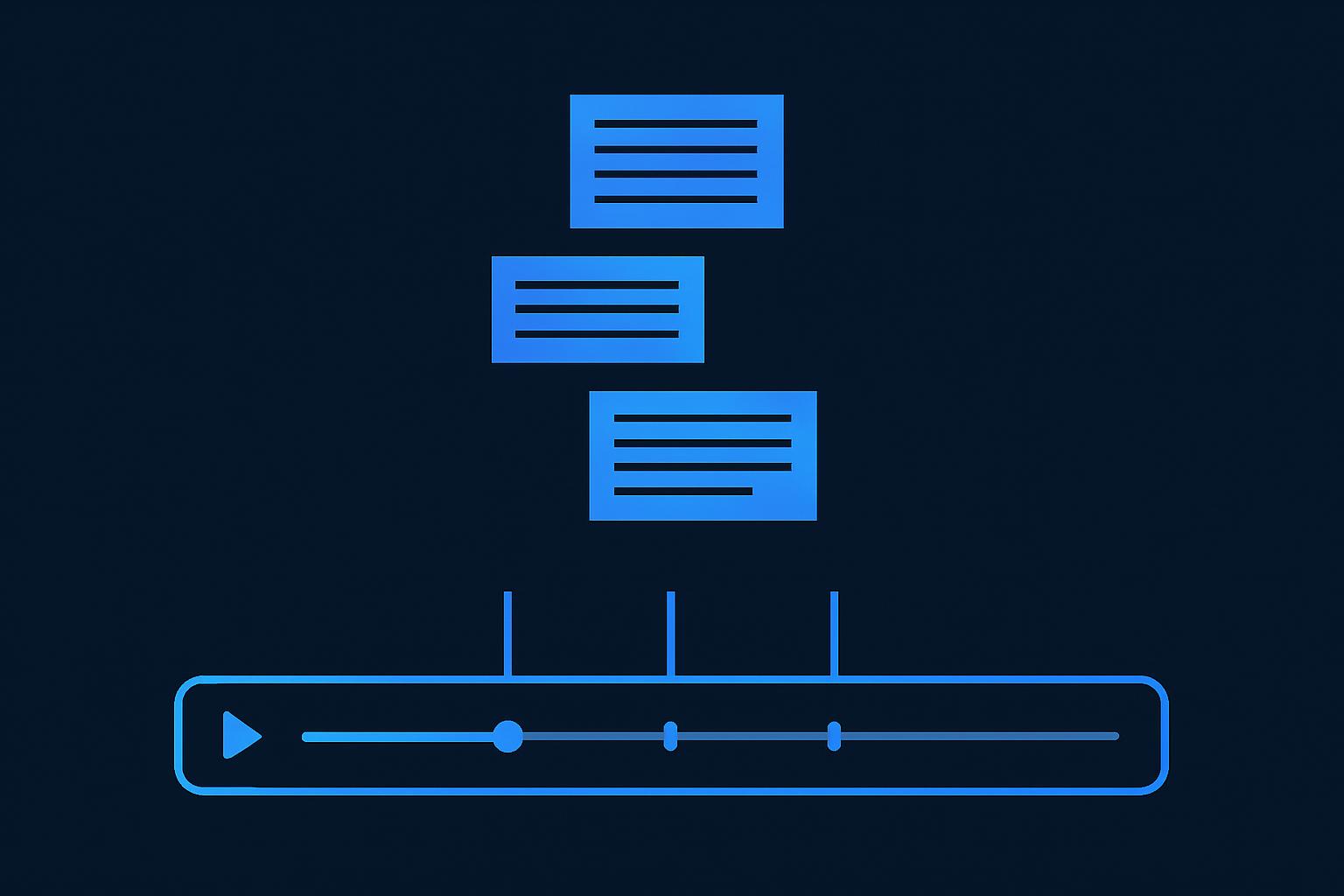
Chapter markers are the highest-leverage structural move on YouTube, and almost nobody uses them. When a video is divided into timestamped chapters, each chapter becomes a separately addressable unit. When Google AI Overviews or AI Mode cite timestamped videos, they often link directly to individual sections — this structure effectively turns a single video into multiple citation points, expanding the opportunities to reference it across different queries.
The data confirms this compounds. 78% of timestamped videos are cited repeatedly, often across multiple sections. Yet the practice is rare: only 31% of AI-cited videos have a chapter structure — yet these are disproportionately cited multiple times. That is a wide-open gap. A structured video gets treated as multiple citable units, the same way an H2-segmented article gives an AI engine multiple clean passages to pull from.
The format requirement is specific and easy to meet. First timestamp at 00:00, at least three chapters, each chapter at least ten seconds long. Think of each chapter the way you'd think of an H2 heading in text SEO — a labeled, self-contained answer to one sub-question. There's one important caveat: this behavior is not universal across engines. Timestamps exist as a citation format exclusively within the Google ecosystem. When Google AI Overviews and AI Mode account for the bulk of your video citations, that concentration is exactly where the timestamp advantage lives.
Views, likes, and subscribers do not matter
This is the finding that breaks most people's YouTube strategy. AI citation of video does not track the metrics YouTube's own algorithm rewards. OtterlyAI analyzed more than 100 million AI citation instances and ran Pearson correlations against every metadata feature. The popularity metrics came back at zero. Views, likes, and subscribers have near-zero correlation with citation frequency (r = -0.03).
The distribution makes it concrete. 40.83% of AI-cited YouTube videos had fewer than 1,000 views at the time of analysis, and 36% carried fewer than 15 likes. Channel size is just as irrelevant: 35% of cited channels had fewer than 10,000 subscribers, and half of cited channels had fewer than 41 videos on their entire channel. The interpretation from the researchers is the key mental model: AI citation behavior resembles reference selection more than recommendation, favoring topic fit and structural clarity over audience scale.
What did correlate was metadata quality. Description length (r = 0.31) and hashtag presence (r = 0.20) emerged as the only metadata variables with meaningful, though still modest, positive relationships with repeated citation frequency. Description length is the single strongest signal in the entire dataset. The average description of a cited video comprises 334 words. The takeaway is not to pad to a word count — it's to treat the description as machine-readable metadata: a real summary of what the video covers, with the entities and terms the transcript reinforces. A practical benchmark is a question-based title, a 500+ word structured description, and timestamped chapters.
| Signal | Correlation with citation | What to do |
|---|---|---|
| Views / likes / subscribers | ~0 (r = -0.03) | Ignore as a citation lever |
| Video duration | ~0 (r = 0.02) | Aim for reference completeness, not a target length |
| Description length | Weak positive (r = 0.31) | Write a real 300–500+ word summary with entities |
| Hashtag presence | Weak positive (r = 0.20) | Include a few relevant, honest hashtags |
| Timestamps / chapters | Drives repeat citation | 00:00 start, 3+ chapters, 10s+ each |
| Transcript accuracy | Prerequisite | Upload a clean SRT, name products clearly |
Long-form, reference-style video wins
Format is destiny. The engines cite documentation, not entertainment. OtterlyAI's analysis found 94.3% of YouTube AI citations go to long-form; Shorts account for just 5.7%. The sweet spot is specific: the largest single citation cluster fell in the 10–20 minute range at 32.1% of cited videos, followed by 5–10 minutes at 26.1% and 20 minutes or longer at 17.6%.
The query types where YouTube shows up tell you what to make. Instructional content is up 35.6% with "how-to" queries leading at 22.4%, and visual demonstrations are up 32.5% on queries for physical techniques. In practice that means tutorials in finance, software, and medical how-to content, plus pricing, deal-hunting, product demos, and reviews. If you run a SaaS, that's your product walkthrough, your onboarding tutorial, your "X vs Y" comparison, and your feature deep-dives — recorded once, chaptered, and transcribed cleanly. The strategic move is to treat long-form as the master asset and short clips as its distribution format, not the other way around.
Platform behavior is fragmented — build for Google
YouTube citations are not spread evenly across engines, and knowing the split tells you where the effort pays off. Perplexity and Google AI Overviews cite YouTube heavily, AI Mode behaves differently, and Gemini and Copilot rarely cite it at all. The share breakdown makes the concentration clear: Google AI Overviews give YouTube 29.5% citation share as the #1 domain; Google AI Mode 16.6%; Perplexity 9.7% as the #5 domain; and ChatGPT just 0.2%, though growing fast.
That distribution should shape your priorities. YouTube is a Google-and-Perplexity play — which is why the timestamp advantage, concentrated in Google's surfaces, matters so much, and why ChatGPT's Bing-based index barely touches video. It also explains YouTube's structural role inside a Google answer. BrightEdge found the engine uses video as a validation layer: rather than relying on single authorities, the system triangulates trust through different content types — video demonstrations from YouTube, discussions from Reddit, specifications, and education from Wikipedia. Video's job in the answer is visual proof. YouTube acts as the validation hub — when Google cites other sources for credibility, YouTube provides the visual proof. And it stands on its own more than most: YouTube carries 40% unique citations, the highest standalone value.
One discipline point for regulated or technical categories. Auto-generated captions frequently misinterpret complex jargon, drug names, and technical terms, and an unedited transcript that misstates a fact misinforms AI models — preventing the video from being cited as a trustworthy source. Correct your transcript before you rely on it. A wrong transcript doesn't just fail to get cited; it feeds the AI reputation problem where engines describe your product incorrectly.
Where YouTube fits in a GEO plan
YouTube is not a replacement for your other citation surfaces — it's a distinct one with its own physics. Reddit earns citations through community consensus. LinkedIn earns them through professional authority. YouTube earns them through structured, transcribed, reference-grade video that gives Google's systems visual proof to triangulate against. The overlap in effort is real, though: a well-executed YouTube SEO strategy that covers metadata depth, chapter structure, transcript quality, and description optimization serves both objectives — they are not competing priorities.
The momentum is worth acting on now. Google's LLMs have expanded beyond transcription to process audio, video structure, chapter markers, and metadata, producing a 34% increase in YouTube citations in AI Overviews over six months. If you already have a video library, most of it is an untapped citation asset that needs three retroactive fixes: add chapters, clean up transcripts, and rewrite thin descriptions. Adding chapters to existing videos gives Google's LLMs a structured map, making it easier to extract and cite specific segments — a retroactive optimization that improves citation eligibility for content you've already produced. That's the fastest win available in GEO right now: no new filming, just structure applied to what you already have. Then track whether it's working with your AI visibility measurement — or start with a free AI visibility report to see where your brand stands today.
Frequently asked questions
Do AI engines actually watch YouTube videos?
No. AI models don't watch video — they read the text around it: the transcript, chapter markers, and description. The transcript is effectively the text version of your video that the model parses to decide whether a passage answers a question. That's why transcript accuracy and metadata quality matter far more than the video itself.
Do I need a large channel to get cited by AI?
No. OtterlyAI's analysis of 100M+ citations found views, likes, and subscribers correlate near zero (r = -0.03) with citation frequency. Over 40% of AI-cited videos had fewer than 1,000 views, and 35% of cited channels had fewer than 10,000 subscribers. AI citation resembles reference selection, not recommendation — the best-structured answer wins, not the biggest channel.
Why do timestamps and chapters matter so much?
Chapters turn one video into multiple separately citable units. Google AI Overviews and AI Mode often link directly to individual timestamped sections, and 78% of timestamped videos get cited repeatedly. The format is simple: first timestamp at 00:00, at least three chapters, each at least ten seconds long. Only about 31% of cited videos use chapters, so it's a wide-open advantage.
Should I use YouTube auto-captions or upload my own transcript?
Upload your own clean SRT. YouTube's auto-captions are optimized for coverage, not accuracy, and misread product names and technical terms. Independent ASR produced 31% fewer word errors on technical content. A wrong transcript can get your video skipped — or worse, feed AI engines incorrect facts about your product.
Which AI platforms cite YouTube the most?
Google AI Overviews lead at 29.5% citation share, followed by Google AI Mode at 16.6% and Perplexity at 9.7%. ChatGPT sits at just 0.2%, and Gemini and Copilot rarely cite YouTube at all. Because timestamp citations are concentrated inside Google's ecosystem, YouTube is primarily a Google-and-Perplexity play.
References
- OtterlyAI — YouTube AI Citation Study 2026
- BrightEdge — Google AI Overviews Holiday Citation Analysis: YouTube Dominance
- Neil Patel — YouTube Citations in AI Overviews Grew 34% in 6 Months
- sipsip.ai — How YouTube Transcript Generators Work: ASR vs Caption Retrieval
- Yotpo — How To Optimize YouTube For AI Citations

Cory Maki is an AI search strategist based in Taichung, Taiwan, specializing in GEO, AI reputation management, and AI branding for SaaS founders. Author of Reddit, AI Overviews & GEO and creator of the ARC Method. Read more →